
✨ Colonial Hospital Report
32
period there is a regular system of cleanliness adopted and efficiently carried out by the Hospital Attendants, aided by the willing co-operation of all the patients who have as yet been admitted, in short, every one seems anxious to contribute their individual share to the promotion of the general comfort of the establishment.
Good effects of The plan originated by His Excellency the Governor-in-Chief.
The mixed plan of mixing the natives and Europeans in the same Wards, I have carried out with the most perfect and satisfactory results, as can be seen by any persons visiting the institution; and although I was at first doubtful as to the practicability of such a plan, I am now firmly convinced that nothing is more easy, and that it is attended with the very best effects, particularly as regards the natives, from the habits of cleanliness adopted on the admission of patients, all disagreeable smell is removed, thereby getting rid of one of the greatest objections to mixing both races. The Wards are now as pure and free from smell as any English Hospital could be; and I have seen with feelings of great pleasure the good and kindly spirit manifested by the white patients towards their darker brethren on all occasions, and the grateful feelings of the latter for acts of kindness which the European patients have been always ready to afford; indeed we have at present one native in particular, in the lower Ward, whose friends never come near him, and who has expressed himself to the white patients in the same Ward in terms of gratitude for what they have done for him, saying also that they alone are his friends.
From these and many other circumstances, therefore, I contend that a bond of reciprocal good feeling will be formed between natives and Europeans, moulded and cemented to a certain extent by this Institution under the mixed system, and which will not be easily broken, for we all know what feelings of sympathy and friendship spring up between individuals attending on each other’s ailments; and I now speak from experience when I say that since the Hospital has been opened nothing but harmony has existed between both races, each and every one ready to assist the other, without any distinction. So far, then, this plan of mixing has been attended with beneficial results.
Practical proofs of the tendency to improve the habits of the natives.
Another good accruing from this plan is, that the natives see the Europeans submitting to many of the things for the cure of their diseases with which they were unacquainted; this in itself is calculated to inspire them with still greater confidence in our art, and a conviction that punctuality and regularity in taking medicine is most important. This was a difficulty I had to contend with in some cases before the opening of the Hospital, as must be self evident.
In almost every instance in which natives have been discharged they have previous to their departure either provided themselves, or been furnished by their friends, with European clothing, although they came to the Hospital in blankets; this they adopt from what they have seen in the Hospital, and from a fear that if they take again to blankets they will die. They also always come to me for rules to guide them when they leave the Hospital, and I have good reason to know that they are not soon forgotten. I was told by one of our European patients who was at Waikanae a short time ago, that the old chief ‘Hingangere’ who was operated on and cured in the Hospital, was lecturing the people of his pa as to what was conducive to their health and what was prejudicial, and that the old chief threw away some stinking karakas which a boy was going to eat, saying that when he was in the Hospital the Doctor told him such food was bad.
Proofs that the first and surest proof that the natives appreciate the Hospital is that it has been always full since its opening. I have had natives from Otaki, Wainui, Manawatu, and other places up the coast, and also from Waikanae, from which place the first native patient was admitted, namely, the old chief Hingangere, who was put under the influence of Sulphuric Ether previous to the removal of a large tumour from between his shoulders. From this native’s son I forward a letter showing how the old man appreciated the Hospital; also a letter from Riwai, the native teacher at Waikanae, whose wife died in the Hospital, as well as a letter from the same person to the Hospital Attendants. I could name all the patients who have been in the Hospital who have expressed themselves grateful, but this is needless. I am, however, far from saying that some may not be found who do not yet appreciate the benefits of this institution, or not yet sufficiently divested of their old predilections for their pas and native habits to at once abandon them in time of sickness and enter our Hospital. All I contend for is, that it has perfectly astonished me as well as persons conversant with the natives that they have up to this time so readily fallen in with our views, including in the number not alone the young men, but also some of the oldest and most influential chiefs. As no institution was ever yet found to please everybody even amongst the most civilized people, so, I suppose, this may fail in some instances; but we must be satisfied with the mass, leaving individuals to time, civilization, and the force of example. Besides, no measures introduced by a civilized nation amongst a half barbarous people for their improvement and good, can be expected to meet with entire success at first; it is only by steady perseverance, having our object in view, that we can hope to see our endeavours crowned with success.
The natives have suffered severely in conjunction with the white population from the effects of the influenza epidemic so prevalent here, but the deaths have been amongst the natives few; inflammation of the lungs, as detailed in a former report, being very common and requiring very active treatment. As to the cause of this epidemic I am unable to speak, except theoretically, as it has not in all probability originated in this country, but has, like some epidemics, travelled from other places, being modified more or less by atmospheric influence or climate in each particular place, accounting for its mildness in some localities and severity in others.
I am sorry to have to report that hooping cough is making its appearance amongst the native children, and I fear that great mortality will ensue, as from the want of proper clothing and care it is very likely to be complicated with inflammation of the lungs, producing a double disease.
I would respectfully call His Excellency’s attention Medical relief for women and children to the subject of medical aid for the women and children, as few women in comparison to the numbers can be accommodated at the Hospital, and no children. It is out of the question now being able to take in more than two women, as the house is too small, and even supposing a wing was built, which is much required, few mothers could leave their children to come into Hospital unless under peculiar circumstances, but in no case could we accommodate children in an establishment of this sort. The only remedy therefore which I see is to afford such cases as cannot be received into Hospital whatever aid it is possible to do at their pas.
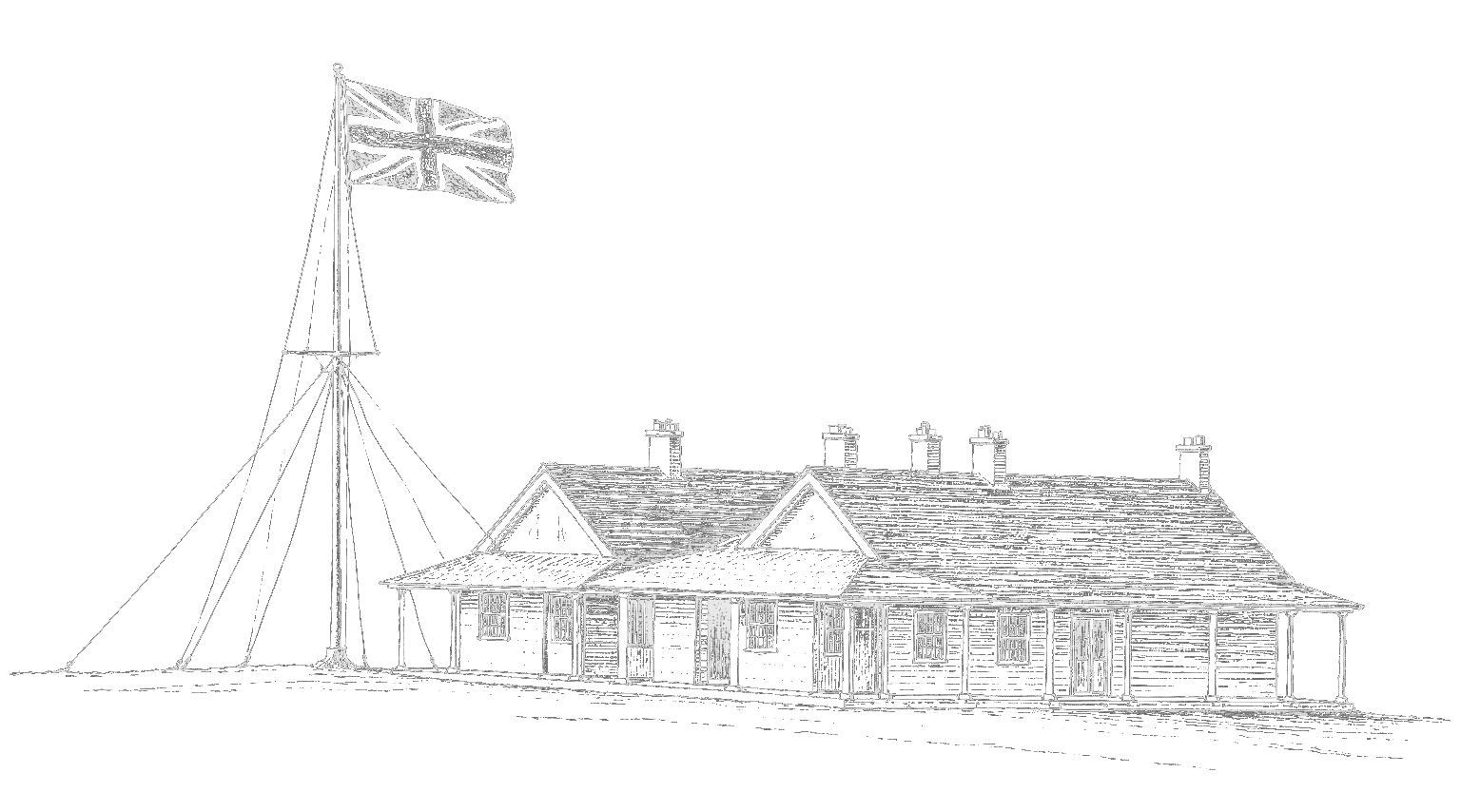
I would strongly recommend the constitution Constituting a Board of Visitors of a board of visitors consisting in part of native chiefs; this would be most desirable and useful, as suggesting inspiring their people with confidence and getting them to enter into our plans and work with us in our endeavours for their good; by getting most desirable the sanction and concurrence of the chiefs we will obtain that of the whole or greater part of the tribe. I have found them useful in my profession both by their advice and authority, and in this case they have promised me their co-operation as soon as His Excellency would call upon them; the names of the different natives I would desire to have as a board I forward for His Excellency’s sanction. In conclusion I would recommend to His Excellency the addition of a wing if possible, as the present Hospital is not large enough for the number of applicants; and I would request to bring under the especial notice of His Excellency the kind, attentive,
Next Page →
 New Munster Gazette 1848, No 7
✨ LLM interpretation of page content
🏥
Colonial Hospital Report
(continued from previous page)
🏥 Health & Social Welfare21 January 1848
Colonial Hospital, Medical Treatment, Patient Care, Wellington
- Hingangere (Chief), Patient operated on and cured
- Riwai, Native teacher at Waikanae