
✨ Colonial Hospital Report
afflict us, there is abundant reason to believe we do not lack in the soil within our tenements, a fever-exciting malaria, but the effects of which have hitherto been ascribed to contagion.
There is no stream within the boundaries of our settlement which deserves the name of a river, though two or three have some claim to the designation; but springs universally abound. Hence there is an abundant supply, whether from these or from wells, of excellent water at all seasons.
Beef, as yet, is not an every day article in our markets, but is becoming more frequent; and, from the increase of cattle, must soon be constant, and at a cheap rate. Mutton of superior quality is to be had daily; and pork, at very moderate price, is sufficiently abundant, and constitutes the chief of our butcher meats. Poultry is very plentiful and low in price; so also are eggs; and a variety of wild fowl is readily to be obtained. Fish is one of our most uncertain dietetic articles.
As the growth of wheat, to the number of our population, is greatly in excess, and more flour is prepared in this than in any other part of New Zealand; and, as hitherto we have had no other markets to occasionally supply than Auckland, Petre, and Wellington, our first quality of the latter is generally from nine to ten pounds per ton; hence those among us who understand and appreciate the importance of the economy of baking at home, can eat their loaf of wholesome household bread at a somewhat less cost than a penny a pound. Potatoes and all culinary vegetables are grown in abundance and very cheaply obtained. Milk, butter, and cheese are within the limits of every one's means; and honey is annually on the increase; and, indeed, promises soon to be found as plentiful in our woods as it is in those of some parts of America. English and other exotic fruits are becoming annually more and more abundant.
Our birth and death statistics demonstrate for the last four years, and our returns go no further back, the very extraordinary annual proportion of from six to seven of the former to one of the latter!
Numerical returns of population fall not within the scope of this report; but I may observe that it is on the increase, whether by births, by the arrival of new settlers from the mother country, or by the return of several who had forsaken the district. In the gross, the population is devoted to agricultural pursuits, or, in one way or other, is rural in its employment.
As respects the Maori population, it may be here remarked, there are many remains confirmatory of the current traditions that that was very dense in this district at not a remote period; or so much so as not now, probably, to exceed a sixth of what it then was. Nor does it appear that this retrogressive march is checked, hitherto, by the instructive exertions of the missionaries, or by the various beneficent appliances of the government, the ratio of deaths to births being about the reverse of ours; and, of late, has considerably exceeded it.
Indeed the mortality within the last few years, and particularly in the last, among this people, over all Taranaki, has been excessive, from the prevalence chiefly of catarrhal disease. And, although the results of a casual epidemic are not generally to be reckoned as a sign of the progressive obliteration of a people, they nevertheless ought to be noticed in this instance as contributory to the forwarding of the catastrophe, as females have been the predominant deaths. I may therefore mention, and as illustrative, too, of the recent general fatality, that in the settlements of the Ngatiruanui tribes (where alone, in so far as has come within my knowledge, some approach to accuracy of census has been ascertained), the deaths within this year have been to the entire population nearly, if not quite, as one to ten!
And another no less remarkable circumstance is that, while among the white population, sterile and childless couples are extremely rare, and numerous, healthy progeny is in actively advancing augmentation, the first of these, among the aborigines, is rather more the rule than the exception; and, as regards the next, few couples indeed are to be met with, who have more than one or two children, and these are, in common, a puny or sickly offspring.
The houses generally, whether of the town or country, are frame built, and of durable sawn timber; but a very few of those in town are of stone, or clay. Those, however, of the last-named material were reared in the infancy of the settlement, and experience soon proved that the soil has not adequate tenacity for the purpose of building; consequently the mode is now altogether abandoned, and the few houses that remain are either about to be removed or are in ruin.
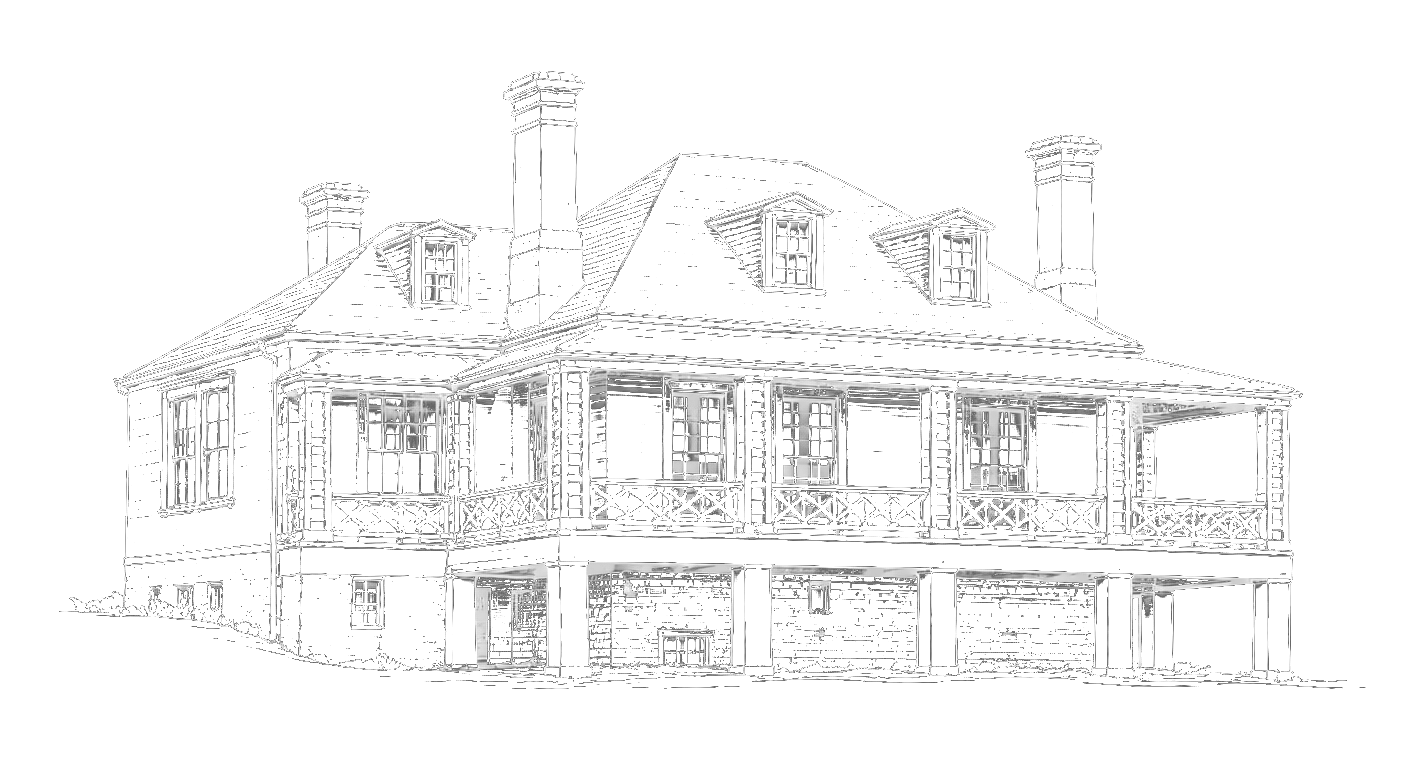
With a few exceptions, none of the houses rise above the ground floor, and pretty generally they are neatly and commodiously constructed for domestic purposes and the maintenance of health. A great proportion of the number are reared on piles, so that the floors are sufficiently detached from the ground to avoid damp, and to admit of free perflation.
This, the New Plymouth Colonial Hospital, was erected by Government in the course of last year, and is substantially and tastefully built, in the Anglo-gothic style, of rimu or red pine. It is particularly well situated on elevated ground, a little above the northern bank of a considerable stream called the "Henui;" and is well sheltered from all the more prevalent and cold winds, by a pretty clump of wood, which fringes the level ground on these quarters, as also densely clothes the side of the dell through which the stream wends.
The accommodation consists of three wards, a surgery or dispensary, a kitchen, a bathroom, and two small closets; with a lobby and passage. These are all on the ground floor, and there is one attic, which serves as a
Next Page →
 New Ulster Gazette 1850, No 9
✨ LLM interpretation of page content
🏥
Colonial Hospital, New Plymouth, Annual Report
(continued from previous page)
🏥 Health & Social Welfare1 December 1849
Annual Report, Colonial Hospital, New Plymouth, Climate, Health, Soil, Swamps, Population, Maori, Agriculture, Housing