
✨ Editorial news and colonial instructions
that there is not more visible union among all who hold lands on honorable grounds in this country. We are not mistaken in the disposition of our Local Government, if, in case of necessity, it do not second every fair and legitimate effort to place the property of this country on a sound and satisfactory basis. His Excellency is an upright, and as far as we know him, a well-judging man. In the meantime, it will not be long before we shall have occasion to enter fully into these matters.
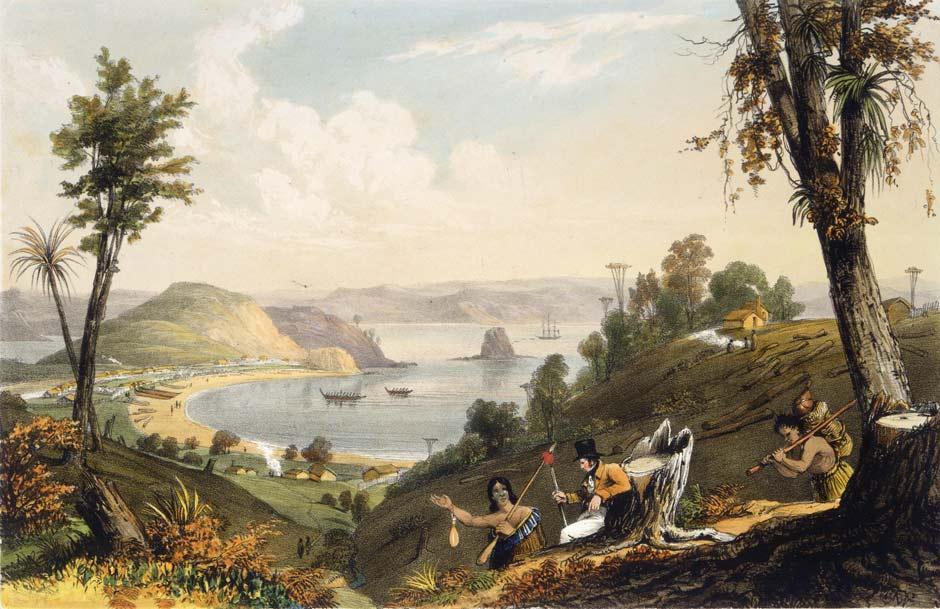
We witnessed on Wednesday the 9th instant, a most animating scene on the Beach of Kororareka. To persons accustomed to such exhibitions it may have afforded no interest, but to us it was perfectly novel, and it may amuse our friends in other Colonies to read a brief and very inadequate description of it. It would have furnished some fine hints for a painter.
Our first attention was directed to a Native group on shore, in front of Clayton & Co’s store. Men, women and children were there collected, and were waving their garments of red and various colours, indicating some strong emotions of joy. We soon perceived, however, in the distance, the cause of this demonstration. It was a fleet of canoes, 14 or 15 in number, all painted red, crowded with Natives. By some signal from the shore they were induced to direct their course to that part of the Beach occupied by the Native Pa. The paddling was singularly in concert. The dresses of the occupants of the canoes being varied in hue and colour, some consisting of red shirts or shawls, some of blankets, some of Native mats, some strictly the European costume, others only half so, consisting only of a covering from the middle downwards, the breast, back and shoulders being bared for the labor of the paddle—altogether caused the little fleet to appear imposing and picturesque. Soon they approached the shore, uttering a kind of noise by no means deficient in harmonious keeping with the scene. As soon as the pointed heads of the canoes reached the edge of the water—each with great rapidity leaped on the Beach, leaving only a few to watch over the contents of their boats. On feeling the ground, they ran in a body with paddles erect towards their friends, and then all at once squatted. Soon, however, they arose and repeated the action. Then standing erect, they leaped in concert many times high from the ground, stretching their paddles high each time like spears. This kind of "corroboree"—if we may so call it, continued a considerable time.
The occasion of this exhibition was the return of Moka, the brother of the Chieftain Rewa, from an expedition of several months. The Natives were afterwards seen in great numbers, each with a basket of kumera, carrying them to the scene of an intending feast.
We have spoken of this occurrence somewhat as we suppose a painter would. There was doubtless the character of uncivilized nature stamped on the scene. But we observed, as we have always done in the Maories, a singular energy and vivacity of mind, united with strong indications of affectionate and kindly dispositions. We hope that such people will never be oppressed by the denial or the deprivation of their rights.
By the late we have Port Nicholson papers, but none of later date than the 10th August. Our first Number appears not to have reached there much earlier than that date, as extracts are made from that Number. From the remarks in the leading article, we infer, that the Sydney Bill had caused a very heavy depression there.
Houses and other buildings continue to start up at Kororareka with singular rapidity. We were counting the other day about a dozen which have made their appearance within the last four or five weeks, or are now beginning to rise from the ground. Besides these, several others are, we understand, on the point of being commenced. It should be remembered that this place has not yet had any connection with the fostering care of an Emigration Commissioner. Its recommendations as seat for commerce are altogether natural.
The forger, O'Donnell, was apprehended by Mr. Spicer, with a party of police, at the island of Kora Kora, on Wednesday the 9th instant. He is now in custody at Russell. He arrives too late for insertion in our last.
A subscriber tells us, that in the list of letters published last week as not forwarded to England and elsewhere on account of the sea postage not being paid, is one, for which he paid that postage a long time ago. We can not tell how many similar oversights have been committed in reference to letters of great consequence?
We witnessed on Monday a breach of private peace in one of the protectors of public peace. One of the police, in quarrelling at his tent door with a woman, who, we think, was his wife, threw a saucepan or kettle of water at her head. They both disappeared within the other tent, and what took place more we know not. Truly, such are goodly guardians of order. We have understood that His Excellency, with a promptness that does him high honour, has begun to act on the hints we furnished in our last Number. We feel confident that the Lieutenant Governor only needs to be correctly informed on public matters, in order to use whatever power he possesses for the welfare of the community.
NEW ZEALAND.
Instructions of the Marquis of Normanby to His Excellency Lieut. Governor Hobson.
(Concluded.)
Amongst the offices thus to be created the most evidently indispensable are those of a Judge, public prosecutor, protector of Aborigines, a Colonial Secretary, a Surveyor General of lands, and a Superintendent of Police; of these the Judge alone will require the enactment of a Law to create and define his functions. The Act now pending in Parliament for the revival with amendments of the New South Wales Act, will, if passed into law, enable the Governor and Legislative Council to make all necessary provision for the establishment in New Zealand of a Court of Justice, and a judicial system separate from, and independent of the existing Supreme Court. The other functionaries I have mentioned can be appointed by the Governor in the mindful exercise of the delegated prerogative of the crown.
Whatever laws may be required for the Government of the New Colony will be enacted by the Governor and Legislative Council. It will be his duty to bring under their notice such recommendations as you may see cause to convey to them on subjects of this nature.
The absolute necessity of a revenue being raised to defray the expense of the Government of the proposed settlements in New Zealand, has not, of course, escaped my careful attention. Having consulted the Lords of the Treasury on this subject, I have arranged with their Lordships, that until the sources of such revenue shall have been set in action, you should be authorized to draw on the Government of New South Wales for your unavoidable expenditure. Separate accounts, however, will be kept of the public Revenue of New Zealand, and of the application of it; and whatever debt may be contracted in New South Wales must be replaced by the earliest possible opportunity. Duties of import on Tobacco, Spirits, Wine and Sugar, will probably supersede the necessity of any other taxation; such duties, except on spirits, will probably be of very moderate amount.
The system at present established in New South Wales to provide for the religious instruction of the inhabitants, has so fully justified the policy by which it was dictated, that I could suggest no better means of providing for this all important object in New Zealand. It is, however, gratifying to know, that the spiritual wants of the settlers will, in the commencement of the undertaking, be readily and amply provided for by the Missionaries of the Church of England, and of other christian communities, who have been so long settled in those islands. It will not be difficult to secure for the European inhabitants some portion of that time and attention which the Missionaries have hitherto devoted exclusively to the aborigines.
I enclose for your information and guidance copies of a correspondence between this department and the Treasury, referring you to Sir George Gipps for such additional instruction as may enable you to give full effect to the views of other Majesty’s Government on the subject of Finance. You will observe that the principle is that of maintaining in the proposed Colony a system of Revenue, Expenditure, and Account, entirely separate from that of New South Wales, though corresponding with it, that correspondence can be maintained.
The accompanying volume of Rules and Regulations for the Colonial Service will place you in possession of many details for the guidance of your official conduct, you will, however, understand, that so much of that volume as relates to correspondence with this department, will not be strictly applicable to your situation. Your correspondence with myself will, as far as may be practicable, be carried on through the Governor of New South Wales.
I have thus attempted to touch on all the topics on which it seems to me necessary to address you on your departure from this Country. Many questions have been unavoidably passed over in silence, and others have been adverted to in a brief and cursory manner, because I am fully impressed with the conviction that in such an undertaking as that in which you are about to engage, much must be left to your own discretion, and many questions must occur which no foresight could anticipate or properly resolve beforehand. Reposing the utmost confidence in your judgment, experience and zeal for her Majesty’s service, and aware how powerful a coadjutor and how able a guide you will have in Sir George Gipps, I willingly leave for consultation between you, many subjects on which I feel my own incompetency at this distance from the scene of action to form an opinion.
I have, &c.,
NORMANBY.
Captain Hobson, R.N., &c., &c., &c.
In the coasting trade of Great Britain there were in 1840, not less than 12,988 British-built coasting vessels employed, the tonnage of which amounted to 2,542,216; the British steamers for foreign trade were 122.
Printed and Published by G. A. Eagar & Co., Proprietors, at the Office, Turner’s Terrace, Bank Square, Kororareka, Bay of Islands, New Zealand, where, and at Mr. M. Murphy’s Rooms, all Orders, Advertisements, and Communications to the Editor are requested to be addressed.
 NZ Advertiser and Bay of Islands Gazette 1840, No 15
✨ LLM interpretation of page content
🏛️ Editorial and local news regarding Kororareka
🏛️ Governance & Central AdministrationKororareka, Local news, Police, Native affairs, Colonial administration
- Moka, Returned from expedition
- Rewa (Chieftain), Brother of Moka
- O'Donnell, Apprehended forger
- Spicer (Mr.), Police officer who apprehended forger
- Hobson (Lieutenant Governor), Mentioned regarding public matters
🏛️
Instructions of the Marquis of Normanby to Lieutenant Governor Hobson
(continued from previous page)
🏛️ Governance & Central AdministrationColonial Office, Instructions, Finance, Judicial system, Missionaries
- Normanby (Marquis), Author of instructions
- Hobson (Captain), Recipient of instructions
- George Gipps (Sir), Governor of New South Wales
- Marquis of Normanby
🏭 Statistics of British coasting trade
🏭 Trade, Customs & IndustryShipping, Trade, Statistics, Great Britain