
✨ Report on Medical Topography of Whanganui District
The food usually consumed is vegetable, with occasionally wild birds, pork, or fish; the drink water, and the fuel wood.
A high degree of intelligence, great attention, and consequently, a retentive memory, are qualities common to the race, and of which the inhabitants of this part of the Islands possess their share. Good humour, hospitality to strangers, liberality to relations, faithfulness to employers, and truthfulness on matters of importance, are the more common favourable characteristics; those of a contrary nature are a disregard of kindness, a love of idleness, jealousy towards members of other tribes, a strong tendency to dissolt and misrepresentation on ordinary matters, corrupt conversation, and promiscuous intercourse between the unmarried sexes.
Marriages with Church service have been lately on the increase, in ten villages within thirty miles of the sea, out of 490 adults 398 are united after Christian practice. Their spiritual condition, or rather the assumed state, may be ascertained by the following numbers of:—
Unbaptized ........................................ 772
Western ............................................ 200
Church of England ............................ 2402
Total 3,374
Attempts have been made at the Missionary stations to form native schools for children, but it does not appear that they have been successful; a regular attendance of scholars is difficult to be enforced, and parental authority never exerted. It is among young men that a desire for improvement is mostly found, and here the influence of an European population becomes directly evident; our mode of buying and selling, the relative value of coins, and the postal communication kept up with the other settlements awaken curiosity and emulation, amidst whose aids the teacher’s task is easy. Out of 730 of all ages, more immediately under the notice of the Church Missionary, 227 can read and write, and 47 perform the first four rules of arithmetic; on making a trading visit to the town it is customary for those who have thus far improved to sell what they have to sell, and to buy what they require on a slate, with which they are generally provided.
Employments and amusements are gardening, agriculture, fishing, spearing birds, making or repairing canoes, weaving mats, (now seldom practised) ornamental carving, Divine services, religious and political discussions, and the general news of the day. With the exception of religious duties, which they perform with a solemnity worthy imitation, the cheerfulness with which they enter upon these occupations give them rather the character of amusements, in fact they have no others forbidher old pastime of Ti, Haka, and similar frivolities are now rarely seen. Their voices are well formed for harmony, but they have no idea of musical effect, and their few barbarous wind instruments are seldom used. The tobacco pipe is a constant source of employment, being seldom out of the mouth, its rise is common to both sexes, and it may be said that all ages, the tobacco used is ungoverned and its bad effects on the system are often observed where used to excess.
It will not be proceeding beyond the province of my report to remark that, when it is considered that the aborigines of this hitherto were always reported to be the worst of a savage race, and that the same causes which operated against the increase of Europeans have ruffled their civilization, the amount of improvement among them now stated is perhaps as much as can be fairly expected. Half a dozen years have not elapsed, since they manifested extreme jealousy of our intentions, and seemed every passing event with careful interest; the settlers at that time unprotected by a military force were made to feel their weakness and round British rule too feeble to give redress. But we now see a friendly confidence in the place of jealousy, a careful avoidance of offence, instead of an upstart at aggression, and some of the principal chiefs who at one time contended and stood hostile with the Government, now seeking distinction in its service. Several leading men are employed as magistrates in administering justice among their own people, and it is a well ascertained fact, that the decision of these officers is never disputed, if found consistent with our laws. It must, however, be confessed that the passions which formerly agitated are slumbering and not extinct.
Europeans first settled in the district in 1840, but several potent causes tended for a long time to render their numbers and labours utterly insignificant. Since the establishment of peace with the natives in 1847, from which period only the birth of the settlement can be dated, the population has increased and its present constitution is:—
Civilians .......................................... 400
Military (with their families) .......... 208
Total 608
This number of civilians is exclusive of those on the neighbouring rivers of Whanganui, Tiraukina, &c. The proportion of males to females, is as 3 to 2; the number of births during the last eighteen months 25, of deaths 3, marriages 5. Nearly three fourths of the population live in the town, the remainder were engaged in pastoral and agricultural pursuits.
The houses of Petre are built usually of wood, of one story and detached, each has a small piece of garden ground, in which are raised some of the fruits and vegetables consumed; there are a few springs of good water on private property, and some wells have been sunk, those near the river are liable to the influx of brackish water, from the occasional presence of which, and the quantity of debris constantly falling into it, the stream inshore is securely fit for ought but external purposes. Ample reserves have been made for streets but as yet no improvement has been made therein.
Provisions are abundant, beef, mutton, pork, fish, fowl, eggs, flour and potatoes, being the articles of diet principally in use.
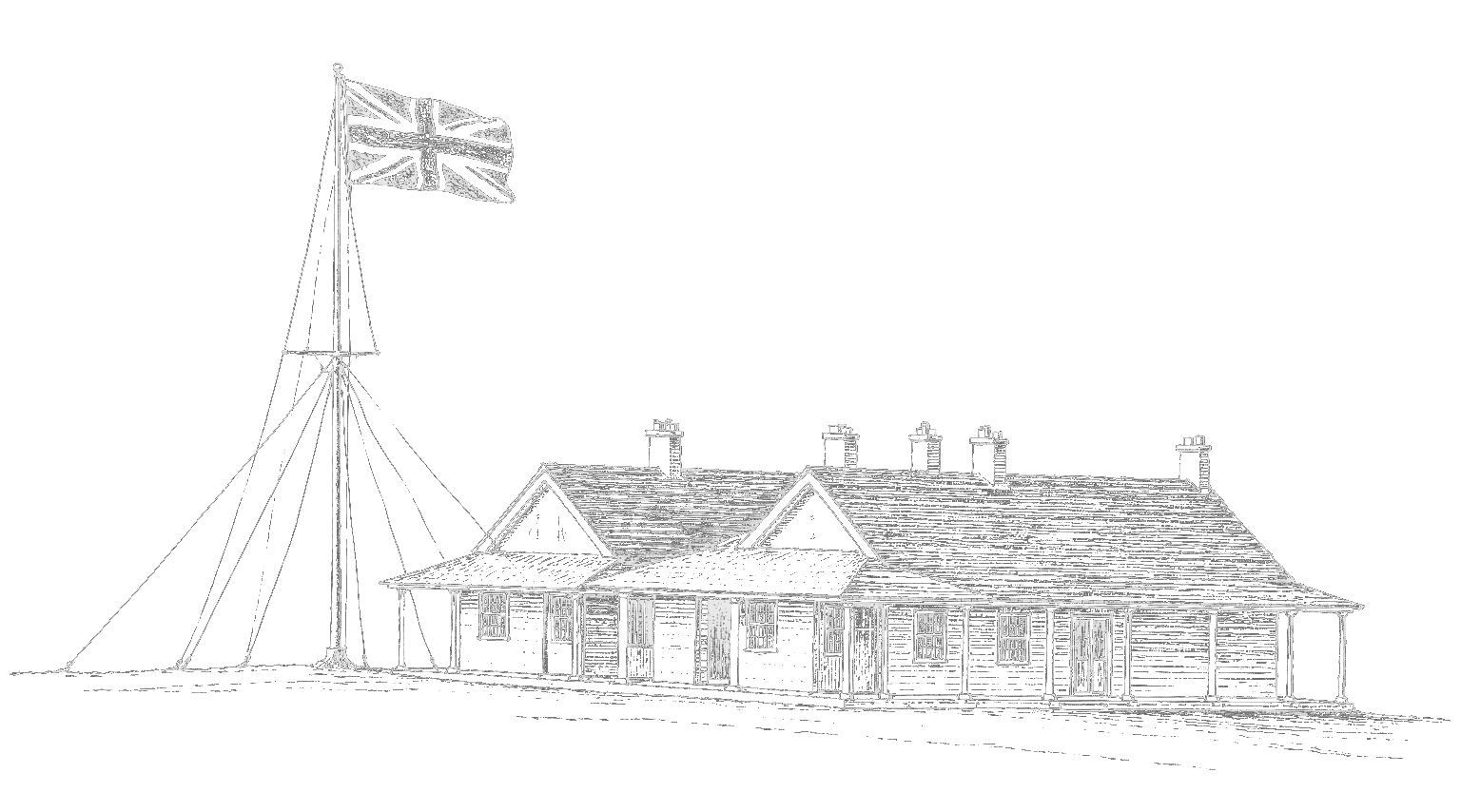
The military inhabit two stockades, formed on hills situated near the centre of the Town, about 150 yards apart and running parallel with each other, at right angles to the river. The men appear to enjoy excellent health. A regular hospital is established in the barracks under the charge of an assistant Surgeon.
A civil Hospital has been recently opened in the Town, intended principally for the reception of aborigines. It is a handsome building, and well situated, every native coming into the Town from the interior, or proceeding up the river from the coast, having to pass it. The size is small, but it is well adapted as the nucleus of a larger building, the arrangements, so far as they extend, are good and calculated to obtain the main object; the rooms intended for the reception of patients are principally on the ground floor and well-ventilated twenty beds, allowing the usual space for each, the others on ventilated are a billiard room, a dispensary, a kitchen, a store apartment to supply the lavatory, water closet, laundry, attendants rooms, and a store closet. The establishment consists of one surgeon, who acts also as dispenser, and a male and female attendant. At the present time the Institution is nearly full, the patients are perfectly aware of the advantages derivable from medical treatment, and place
Next Page →
 New Munster Gazette 1851, No 29
✨ LLM interpretation of page content
🏥
Report on Medical Topography of Whanganui District
(continued from previous page)
🏥 Health & Social WelfareWhanganui River, Medical Topography, District Report, Climate, Soil, Animal, Vegetable, Mineral Productions, Agriculture, Roads, Population